
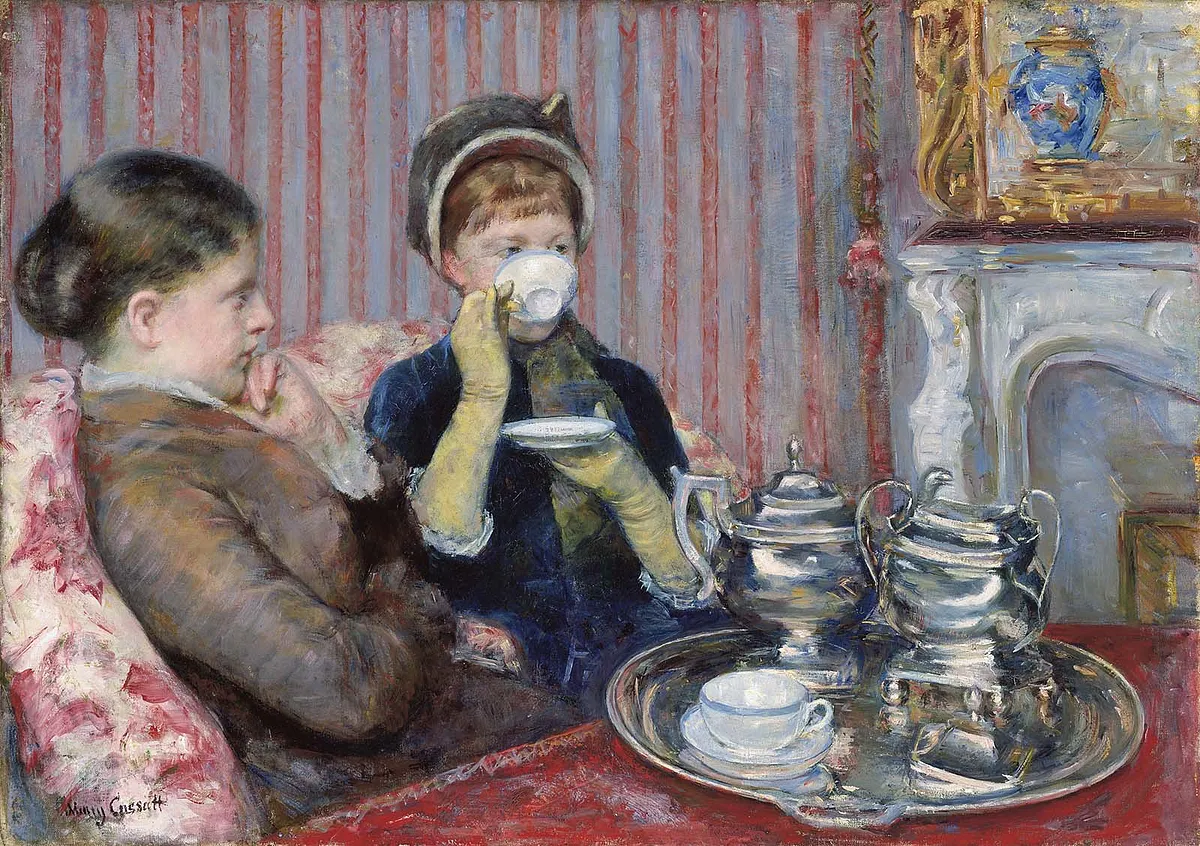
Mary Cassatt returned to the tea table again and again in the late 1870s and early 1880s. Around 1880 she painted The Tea, now at the Museum of Fine Arts, Boston; a few years later came Lady at the Tea Table, now at the Metropolitan Museum of Art, along with The Cup of Tea and several prints.1
Part of the reason is practical. Tea was part of the normal daily routine for women of her family and class, a world she could paint from the inside. The other part is artistic: a tea table gave her exactly the kind of modern, storyless moment the Impressionists were after.
An American in Paris
Cassatt was born in 1844 in Allegheny City, Pennsylvania, now part of Pittsburgh. Her father was an investment banker, and her brother Alexander later became president of the Pennsylvania Railroad. She was admitted to the Pennsylvania Academy of the Fine Arts at fifteen, didn't care for its formal training, and moved to Paris four years later. She studied briefly with Jean-Léon Gérôme but mostly taught herself by copying paintings in the Louvre.2
In 1874 she settled in Paris for good. That year, Edgar Degas saw one of her paintings at the Salon and said, "There is someone who feels as I do." Around the same time, Cassatt saw some of his pastels in a shop window. "It changed my life," she wrote. "I saw art then as I wanted to see it."2
In 1877 Degas invited her to exhibit with the independent artists later called the Impressionists. "I accepted with joy," she recalled. "I hated conventional art." She was one of only a few women, and the only American, to show with the group.1
The family arrives
The same year, 1877, her parents and her older sister Lydia moved to Paris to live with her.2 For the next several years her family, and Lydia above all, became her most frequent subjects. Lydia appears crocheting in the garden, at the opera, and driving the family's small carriage through the Bois de Boulogne.3
There was also a limit on what Cassatt could paint. As the Smithsonian American Art Museum puts it, the cafés, clubs, and streets her male colleagues painted were not comfortably open to a genteel woman in nineteenth-century Paris. The domestic world became her territory, and she painted what women did there: caring for children, reading, crocheting, pouring tea, and spending time with each other.2
The Tea, about 1880
The Tea is set in an upper-middle-class Paris drawing room with striped wallpaper and a carved marble fireplace. Two women sit at a table. The hostess, in a brown day dress, rests her chin on her hand. The guest, still in her hat and gloves, is mid-sip, her face almost hidden behind the cup.1
The hostess is often identified as Lydia. The Museum of Fine Arts, which owns the painting, is more cautious: the two women may just as well be Cassatt's regular models, who appear in her opera scenes too.1
The real subject might be the silver tea service, which is painted larger and more carefully than either woman. It was the Cassatts' own, part of a family set made in Philadelphia around 1813. Six pieces of it, not including the tray, are now in the same museum as the painting.1
When The Tea was shown at the fifth Impressionist exhibition in 1880, not everyone was convinced. The critic Paul Mantz called it "poorly drawn" and mocked the "wretched sugar bowl [which] remains floating in the air like a dream." Joris-Karl Huysmans, more sympathetic, guessed from the subject that "Miss Cassatt is evidently also a pupil of English painters" and called it an "excellent canvas." The collector Henri Rouart bought it soon afterward.1
Lady at the Tea Table, 1883–85
Lady at the Tea Table is a portrait of Mary Dickinson Riddle, a first cousin of Cassatt's mother. She sits behind a gilded blue-and-white porcelain tea service from Canton, with her hand on the teapot. The service had been a gift from Mrs. Riddle's daughter to the Cassatt family, and Cassatt painted the portrait in appreciation.4
The Met describes the scene as "a daily ritual among upper-middle-class women on both sides of the Atlantic." The thank-you didn't go as planned. The Riddle family reportedly disliked the portrait, and it stayed with Cassatt for decades until she gave it to the Met herself in 1923.4
Why tea, and why it mattered
Lydia died in 1882, and with her went Cassatt's most constant model at the tea table. In the 1890s Cassatt turned to the mothers and children she's best known for today. In later life, as her eyesight failed, she worked increasingly in pastel, as Degas had.2 She died in France in 1926.
Her tea pictures sit at the center of what she achieved. A tea table was an acceptable subject for a well-off woman artist, but Cassatt used it to do something radical. She made the cup more important than the face behind it, refused to tell a story, and painted the silver as boldly as the sitters. The museum puts it simply: the painting was "a declaration of modernity."1
She was also painting the afternoon tea of a real household: her family's silver, her mother's cousin, her sister. For how a Chinese leaf became a daily ritual in Europe and America, see A Short History of Tea. And if a pot for two sounds like a good idea this afternoon, our guide to how much loose leaf to use per cup will get the measure right.
The image at the top of this page is The Tea itself, which is in the public domain.5
More from our Tea in Painting series: Chardin, Carl Holsøe, William Henry Margetson, and Henri Matisse.