
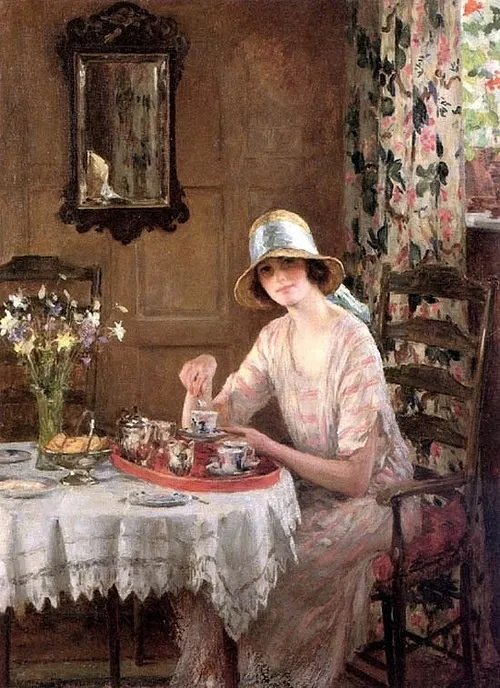
Afternoon Tea is a painting by the English artist William Henry Margetson of a young woman in a pale summer dress and cloche hat, stirring her tea at a lace-covered table set with a silver tea service, a basket of cake, and a vase of spring flowers. She looks up as if someone has just come in.
Not much is recorded about the painting itself. One reference dates it to 1915.1 But it sums up the second half of Margetson's career: after years illustrating adventure stories, he became known for exactly this kind of picture, a woman at home, at rest, in a quiet room.
A London boyhood and the Royal Academy
Margetson was born on 1 December 1861 at Denmark Hill in south London, the younger son of Edward Margetson, an export merchant from Yorkshire, and Eleanor Bradshaw, an engraver's daughter. He went to Dulwich College, then studied at the National Art Training School in South Kensington and, from 1878, at the Royal Academy Schools, where he won several prizes.2
By 1885 he had his own studio on Great Ormond Street and had begun exhibiting at the Royal Academy, where he showed regularly until 1922.2
Adventure stories and Bible pictures
Like many painters of his generation, Margetson earned much of his living from illustration. He worked with the journalist and novelist Joseph Hatton on the English Illustrated Magazine, illustrated four of G. A. Henty's boys' adventure novels in the 1890s, and in 1904 provided pictures for Hurlbut's Story of the Bible. He became popular in the 1890s as an illustrator of adventure stories and fairy tales.2
His biggest success as a painter came in 1897 with The Sea Hath Its Pearls, a classical-style young woman by the sea, in a round frame carved with crabs. It was chosen for the Art Gallery of New South Wales by the Council of the Royal Academy and bought directly from the artist the year it was shown. The Sydney gallery candidly calls him "one of the lesser genre painters and portraitists" of his time.3
Family, and the move to the country
The Hatton connection led to more than work. In 1889 Margetson married Joseph Hatton's daughter, Helen, at St Mark's Church in Marylebone.2 They had three children, and their eldest daughter, Hester Margetson, became a painter and illustrator too.2
In 1902 the family left London for the village of Blewbury, then in Berkshire, and around 1925 moved to Priory Cottage on the High Street in Wallingford, on the Thames. Margetson died there on 2 January 1940, survived by his wife and all three children.2
Painting women at home
Over time Margetson concentrated more and more on painting, and above all on young women. He built a reputation, as one gallery biography puts it, as "a painter of beautiful young women, sitting or standing in contemplation, at home or in the garden."2
Tea suited that subject perfectly. By his time, afternoon tea was a settled English institution, a light meal of tea, small sandwiches, and cake that had developed through the nineteenth century alongside the heartier high tea.1 It was the part of the day when a household paused. A woman at a tea table, cup in hand, gave Margetson everything he liked to paint: a reason for his sitter to be still, a light-filled room, flowers, silver, and lace.
What the painting tells us
Look closely at Afternoon Tea and it's a portrait of an English domestic ideal from his era: patterned curtains, a ladder-back country chair, a carved mirror on paneled walls, a red tray of silver and china. The woman isn't hosting, and she isn't a servant. She's taking a few minutes for herself, and she's been caught in the act.
That's also why the picture has outlived its painter's reputation. Its date is uncertain, and we couldn't find it in any public collection. But it's widely reproduced, and Denmark's national encyclopedia uses it to illustrate its entry on afternoon tea itself.1
Your own afternoon tea
You don't need the silver or the hat. For the British side of tea's story, start with A Short History of Tea. For the tea itself, our guide to reading a black tea label explains the Assams and Darjeelings that filled English pots, and our black tea timer will handle the steeping while you find the cake.
The image at the top of this page is Afternoon Tea itself, which is in the public domain.4
More from our Tea in Painting series: Chardin, Mary Cassatt, Carl Holsøe, and Henri Matisse.