
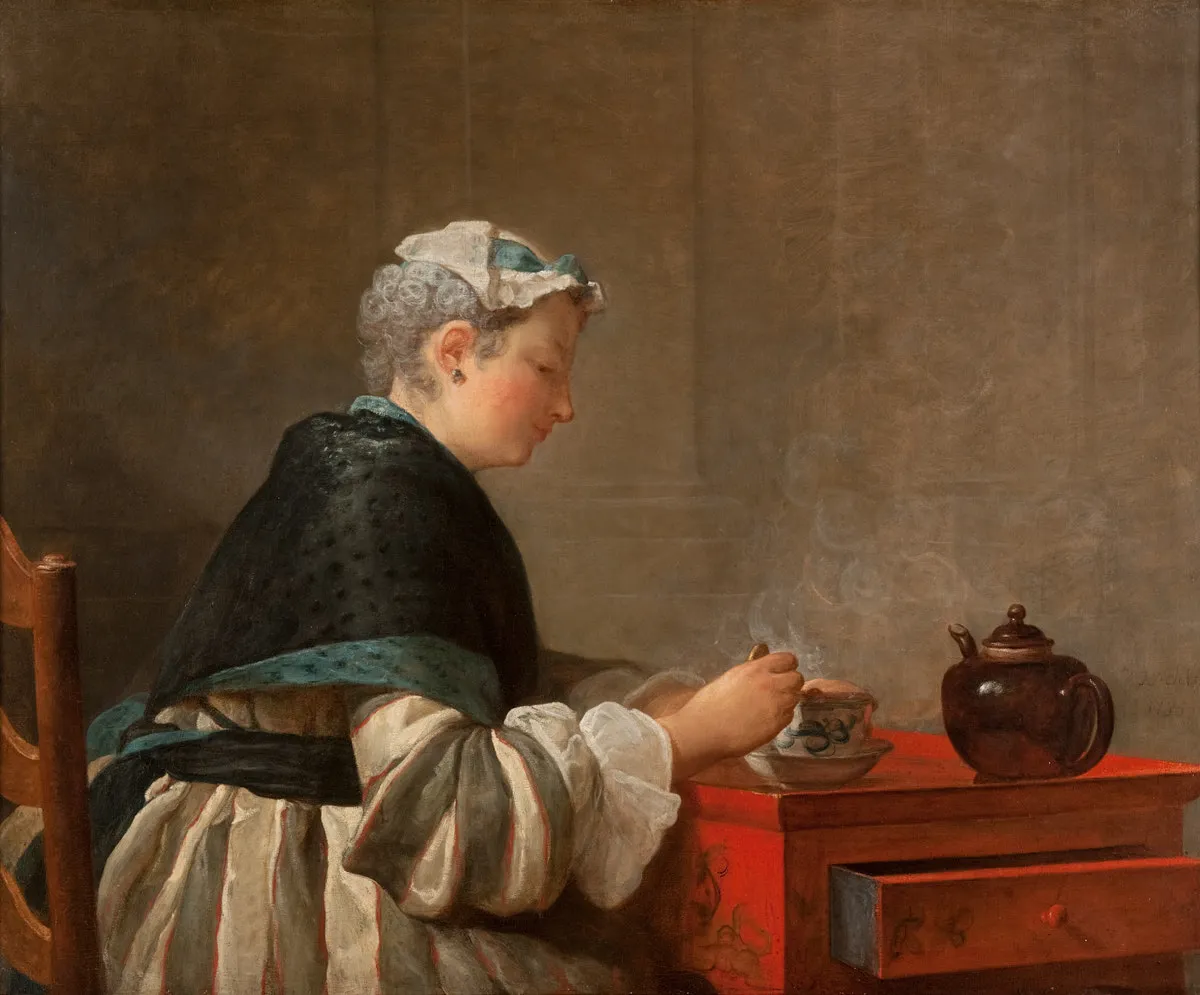
A Lady Taking Tea was painted in Paris in 1735 by Jean-Siméon Chardin, a cabinetmaker's son who had made his name painting fruit, game, and kitchen pots. It shows a woman at a small red table, stirring a cup of tea as the steam drifts past a brown teapot. It hangs today in the Hunterian Art Gallery at the University of Glasgow, which considers it one of his greatest achievements.1
It's a small, quiet picture of a very ordinary moment. That's what makes it interesting: Chardin had only recently started painting people at all, and tea was still a novelty in France.
A painter of animals and fruit
Chardin was born in Paris in 1699. He trained with the painter Pierre-Jacques Cazes, assisted Noël-Nicolas Coypel, and passed through the Académie de Saint-Luc, the painters' guild, before he was received into the Royal Academy in 1728 as a painter "of animals and fruits."23
That was both an achievement and a limitation. The Academy ranked still life far below history, mythology, and court subjects, so admission as a still-life painter was a rare honor in a lowly category.4 His subjects were the objects of the middle-class household he came from: copper pots, loaves, a dead hare, a glass of water.
Why he started painting people
The traditional explanation comes from people who knew him. Chardin, it was said at the time, was teased into painting the human figure by his friend, the portraitist Jacques Aved. According to the collector Pierre-Jean Mariette, writing about fifteen years later, his first figure painting was a young man blowing soap bubbles, studied from a model.5 The National Gallery of Art in Washington dates its version of Soap Bubbles to about 1733–34.
From the early 1730s until the early 1750s, genre scenes made up most of his work. He drew on seventeenth-century Dutch painting, where pictures of one or two people absorbed in a household task had a long tradition.3 Chardin brought a still-life painter's patience to them. His figures are as solid and quiet as his copper pots, and they're always in the middle of something small: drawing, sealing a letter, building a house of cards, stirring tea.
The year of the painting
In 1731 Chardin married Marguerite Saintard. She died in 1735, only four years after the wedding, leaving him with a young son, Jean-Pierre.2
Writers have long wondered whether the woman at the tea table is Marguerite. There's no way to prove it. But the picture was painted the year she died, of a woman alone with a cup of tea, and it's hard to look at it without thinking about that.
The painting had a partner. Chardin conceived a House of Cards, showing a young man absorbed in his own careful, fragile task, as its pendant.6 The two were separated in the eighteenth century and shown together again for the first time at the Hunterian in 2008.7 Side by side, they're both about attention: a few minutes spent entirely on one small thing.
Tea as a new luxury
In 1735, the painting recorded a habit that was still fairly new to Europe. The Hunterian notes that it reflects two fashions at once: the drinking of tea and the taste for chinoiserie, the craze for Chinese and Chinese-style goods.8 Look at the table: the cup is blue-and-white porcelain in the Chinese manner, and the teapot and red lacquered table would have read as equally fashionable.
The museum now hangs the painting at the center of a room called "The World in a Teacup." The label there spells out what a cup of sweetened tea involved. Tea came from China on European trading ships, and the sugar stirred into it was produced by enslaved people on plantations in the Americas. Together, the gallery notes, tea and sugar became a domestic ritual "signifying luxury and respectability," built on systems of exploitation far from the drawing room.1
None of that is visible in the picture, and that's part of the point. Chardin shows the ritual the way its drinkers experienced it: warm, private, a few minutes to oneself.
What came after
Chardin married again in 1744, to Françoise-Marguerite Pouget. He showed at the Salon from 1737 until his death, served as treasurer of the Academy for nearly twenty years, and received commissions, pensions, and lodgings in the Louvre from Louis XV.2 In the 1750s he returned to still life, and at the end of his career made a few pastel portraits.3
A Lady Taking Tea was acquired by William Hunter, the Scottish anatomist and collector, who left his whole collection to the University of Glasgow when he died in 1783.1
Looking at it now
What still strikes people about the painting is how little happens in it. A woman stirs her tea and waits for it to cool. The steam gets as much care as her shawl.
That's a fair description of a good cup of tea at home, too. If you'd like to give a cup that kind of attention, our guide to making tea a daily ritual is a good place to start, and A Short History of Tea explains how the leaf reached a Paris tea table in the first place.
The image at the top of this page is A Lady Taking Tea itself, which is in the public domain.9
More from our Tea in Painting series: Mary Cassatt, Carl Holsøe, William Henry Margetson, and Henri Matisse.