
Henri Matisse painted Tea in the summer of 1919, in the garden of his family home at Issy-les-Moulineaux, just outside Paris. It's a big canvas, more than two meters wide, now at the Los Angeles County Museum of Art.1 Two women sit at a garden table in the shade, a dog sprawls on the path, and the light comes down through the leaves in patches.
The woman in the foreground is his daughter Marguerite, and the painting comes near the end of years of pictures of her at home. To understand it, it helps to know her story as well as his.
From law to painting
Matisse was born in 1869 in northern France, into a family of weavers. He studied law, then gave it up at twenty to train as an artist in Paris.2 By the early 1900s he was painting in such loud, unnatural color that critics called him and his circle the Fauves, the "wild beasts." In a 1908 essay he wrote that expression, for him, lay not in faces or dramatic gestures but in "the entire arrangement of my picture."2
His daughter was part of that work almost from the beginning.
A "studio child"
Marguerite was born in Paris in 1894, to Matisse and his model Caroline Joblaud. He legally recognized her in 1897, and when he married Amélie Parayre, Amélie offered to raise Marguerite as her own. She grew up alongside her half-brothers Jean and Pierre.3
At seven she caught diphtheria and needed an emergency tracheotomy. The damaged larynx made her ill for years and interrupted her schooling, and she covered the scar with high collars and then a black ribbon at her throat. Kept at home, she became what the Musée d'Art Moderne de Paris calls a thoroughgoing "studio child," watching her father work every day. "The spirit of the family was entirely focused on father's efforts," she later said.3
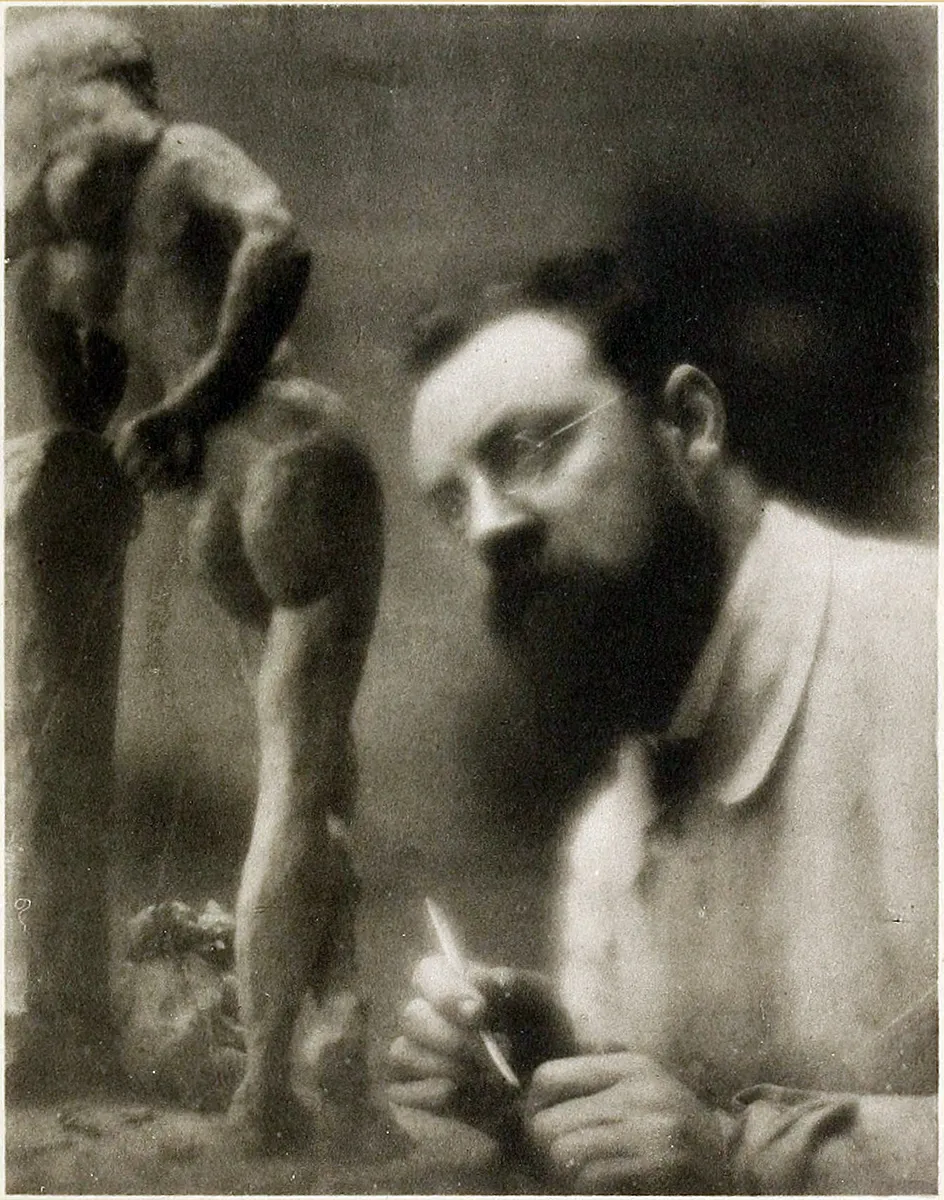
She was also his most patient model. Matisse painted her as a little girl, as a teenager staring down the viewer, and, in 1910, holding a black cat. By then the family had moved into a large house with a garden at Issy-les-Moulineaux.3 The photograph at the top of this page shows Matisse there in 1909, modeling a sculpture; it was taken by Edward Steichen.4
The war years, and a new light
Portraits of Marguerite multiplied during the First World War, showing her as an elegant young woman in elaborate hats. In 1917 Matisse first went to Nice, and the Mediterranean light changed his painting. He spent more and more time there, and Marguerite came to visit and posed on the balcony of his rooms overlooking the sea.23
Back in Paris in the autumn of 1918, he painted another series of her indoors, in darker, more melancholy colors, with a different hat each time. In May 1919 she had another operation on her trachea.3
Tea, summer 1919
That summer, Marguerite sat for Tea in the garden at Issy. In the painting she leans back in a green chair on the right, the black ribbon still at her neck. A second woman in white sits across the table. On the table are a tall metal urn, a jug, cups, and fruit. A dog lies in the middle of the path.
The Musée d'Art Moderne de Paris, which devoted a 2025 exhibition to father and daughter, points out something about this canvas: it was the first time Marguerite had been paired with another female model. "A chapter was about to end," the curators write.3 She would sit for him less and less, and the garden at Issy was giving way to Nice.
There's nothing ceremonial about this tea. Nobody is pouring, and nobody's looking at anybody else. It's what tea in a family garden actually looks like: the cups are out, the afternoon is warm, and everyone has drifted into their own thoughts. The dappled shade gets as much of Matisse's attention as either face.
What happened next
In spring 1920 Marguerite had a final operation, which freed her at last from the ribbon. There would "merely be the trace of what had earlier been a hole," she wrote. Matisse took her to Étretat on the Normandy coast to recover, and painted her there asleep, her throat finally bare.3
In 1923 she married the writer Georges Duthuit and stopped appearing in her father's paintings. She became his representative in Paris instead, dealing with collectors, dealers, and museums, overseeing the printing of his engravings, and later helping organize his retrospectives in Paris and New York.3
Tea was sold through the Paris gallery Bernheim-Jeune in 1920. In 1925 it was bought by Michael and Sarah Stein, American collectors living in Paris, who later took it home to California. It came to LACMA in 1974.1
Tea in the garden
Most of Matisse's famous interiors are about color and pattern. Tea is about shade, the way a garden feels on a hot afternoon, and a family at the end of one chapter of its life.
If you'd like to try the outdoor version this summer, our guide to cold brew tea makes a pitcher that's happy to sit on a garden table, and making tea a daily ritual covers the rest.
More from our Tea in Painting series: Chardin, Mary Cassatt, Carl Holsøe, and William Henry Margetson.