
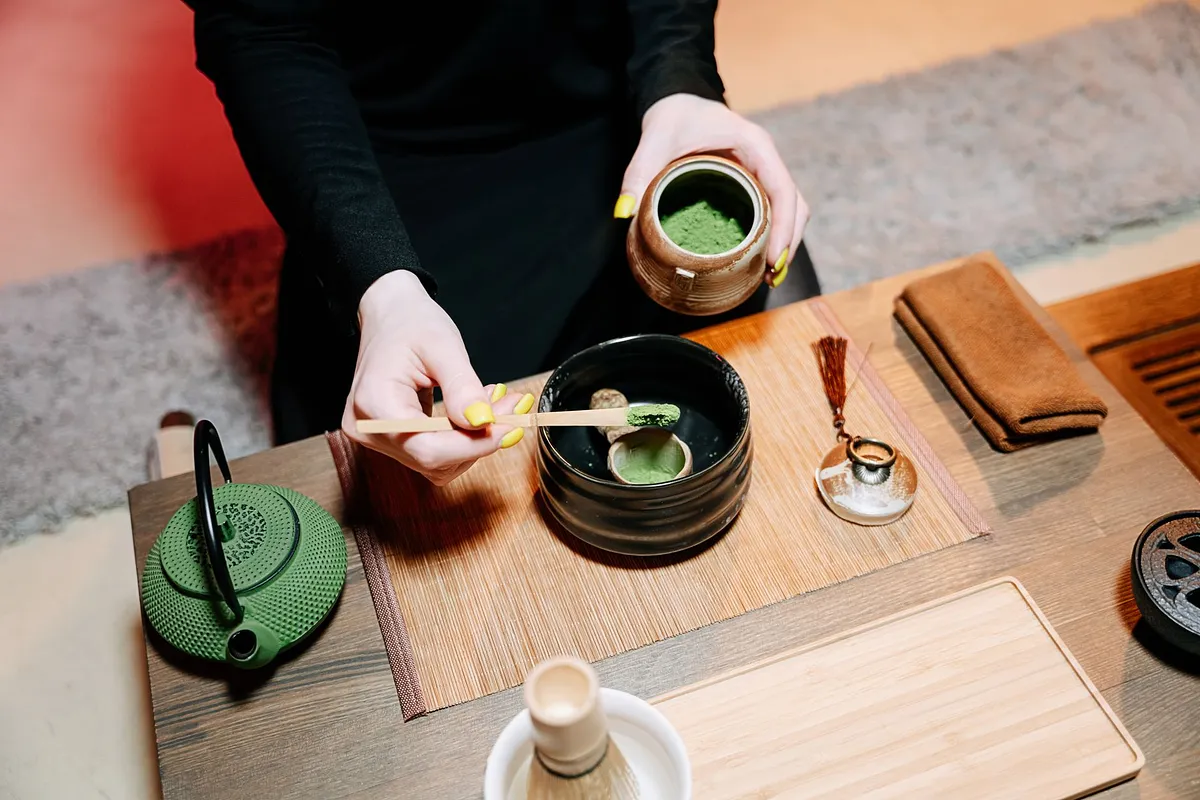
A Japanese tea ceremony, called chanoyu or sado, is a choreographed gathering where a host prepares and serves matcha to guests. Guests eat a small sweet, receive the bowl, turn it before drinking, and admire the utensils. A short gathering takes under an hour; a full formal one, with a meal, about four.
It can look from the outside like a set of rules waiting to be broken. It's better understood as hospitality refined over centuries, where every movement exists to make the guest comfortable and the moment attentive. Here's what actually happens, and why.
Where it comes from
Tea came to Japan from China with Buddhist monks, who drank it to stay alert through long meditation. The Zen monk Eisai is credited with popularizing powdered tea in the late 12th century, after returning from China.
The ceremony as it's practiced today owes most to Sen no Rikyu, a 16th-century tea master. Rikyu moved tea away from displays of expensive Chinese ceramics toward something quieter: small rooms, simple local utensils, and an aesthetic of rustic, imperfect beauty now known as wabi.
He's associated with four principles that still define the practice:
- Wa — harmony, between host, guests, and season
- Kei — respect, for people and for objects
- Sei — purity, physical and mental
- Jaku — tranquility, the state the first three make possible
Today the main schools, including Urasenke and Omotesenke, descend from Rikyu's family.
The setting
Ceremonies traditionally take place in a chashitsu, a small tea room, often about the size of four and a half tatami mats. Some have a tiny entrance, the nijiriguchi, low enough that every guest has to bow to enter — a reminder that inside the room, rank doesn't matter.
There's usually an alcove, the tokonoma, holding a hanging scroll and a simple flower arrangement chosen for the season. Guests look at these on entering; they set the theme of the gathering.
Two kinds of gathering, two kinds of tea
- Chakai: a relatively short gathering, often under an hour, serving sweets and thin tea. This is what most visitors experience.
- Chaji: the full formal event, around four hours, with a multi-course meal, thick tea, and thin tea.
The tea itself comes in two styles:
- Usucha (thin tea): matcha whisked with more water until frothy. Lighter and a little bitter. Each guest usually gets their own bowl.
- Koicha (thick tea): much more matcha, much less water, kneaded rather than whisked into something like warm paint. Made with the finest matcha, and traditionally shared from one bowl.
What happens, step by step
A typical thin-tea serving looks like this:
- The host purifies the utensils in front of the guests, wiping the tea caddy and scoop with a silk cloth and rinsing the whisk. It's done slowly, as part of the ceremony rather than preparation for it.
- Guests eat a sweet. A small seasonal confection, or wagashi, comes first. Its sweetness balances the bitterness of the tea to follow.
- The host prepares the tea. Matcha is scooped into the bowl, hot water is added, and it's whisked with a bamboo chasen until a fine foam forms.
- The bowl is presented with its most decorative side, the "front," facing the guest.
- The guest receives it. They bow, lift the bowl, and turn it a quarter or so clockwise, so they don't drink from the front — a gesture of humility toward the bowl and the host.
- They drink in a few sips, finishing with a small audible slurp to show they've enjoyed it.
- They wipe the rim with their fingers, turn the bowl back, and set it down to admire it.
Afterward, guests may ask about the utensils — who made the bowl, the name of the tea scoop — which is part of appreciating the host's choices.
If you're attending as a guest
Nobody expects a first-time visitor to know the forms. The host or another guest will usually guide you. A few things that help:
- Wear clean white socks; you'll be on tatami
- Remove rings and watches so you don't scratch the bowls
- Follow the guest ahead of you
- Don't worry about getting it wrong — attention matters more than precision
What it offers outside Japan
You don't need a tea room to borrow the core idea. The ceremony is about preparing something simple with full attention and offering it to someone else. Whisking a bowl of matcha slowly at home, with the phone in another room, captures more of it than you might expect.
If you'd like to try, start with good matcha — our guide to telling good matcha from bad explains what to look for — and see our guide to Japanese teaware for the few tools you need. Our matcha timer will keep the water in range.