
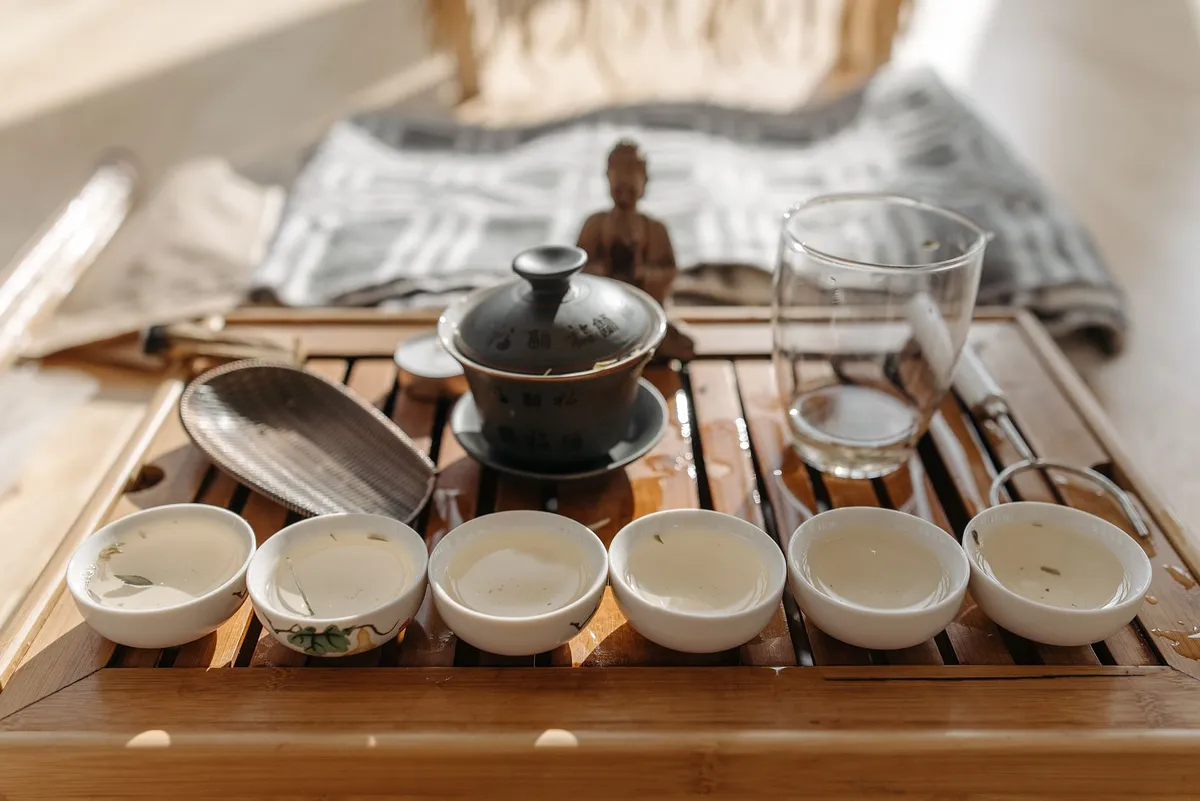
Gongfu cha means roughly "tea made with skill" — a way of brewing that uses a small vessel, a lot of leaf, and many short infusions instead of one long steep. A session takes fifteen or twenty minutes and produces six or eight cups, each one different from the last.
The style grew up in the Chaozhou region of southern China, where small pots of oolong were (and still are) passed around among family and neighbors many times a day. It's often presented as a ceremony with rules you can fail at. It isn't. It's a method, and the only thing it really asks of you is attention.
What makes it different
Ordinary Western brewing puts a little leaf in a lot of water for several minutes. Gongfu inverts that: a lot of leaf in a little water for a few seconds.
Concretely, that's around 5–7 grams per 100 ml — several times the usual ratio — with the first infusion often lasting only fifteen or twenty seconds. Because the contact time is so short, you extract the immediately available flavors and stop well before the tannins responsible for astringency have much chance to emerge.
Then you do it again. And again. Each round pulls a slightly different mix from leaves that are progressively more open, which is why the fourth cup can taste like a different tea from the first.
Why it produces better tea
Two reasons, and the second is the more interesting one.
The obvious one: shorter steeps mean less bitterness, so you can use concentrated amounts of leaf without punishment. A gongfu cup is intense and sweet at the same time, which a mug-steep can't easily manage.
The subtler one: it separates a tea into its parts. In a single four-minute steep, everything the leaf has to offer arrives simultaneously and averages together. Spread the same leaf across eight infusions and you get to taste the sequence — the bright top notes early, the body in the middle, the lingering sweetness at the end. You learn more about a tea in one gongfu session than in a month of mugs.
What you need
Less than the photographs suggest:
- A small vessel. A gaiwan (a lidded bowl, 100–150 ml) is the standard and the cheapest. A small teapot works.
- A pitcher to pour the finished infusion into, so the tea stops extracting and everyone's cup is the same strength.
- Small cups. 30–50 ml. The size is functional: a small cup is finished before it cools.
- A kettle you can keep hot.
A tray to catch spills is traditional and genuinely useful, but a towel does it.
A session
- Rinse the leaves. Fill, pour off immediately, discard. Wakes them up; essential for compressed teas.
- First infusion: 15–20 seconds. Fill, cover, pour out completely into the pitcher.
- Pour out completely, every time. Water left in the vessel keeps extracting and makes the next round bitter. This is the rule beginners skip.
- Add about 5 seconds per round. The leaves give up flavor more slowly as they go.
- Smell the wet leaves between infusions. The aroma changes across a session more than the liquor does, and it's the fastest way to start noticing things.
- Stop when it goes thin. Usually six to eight rounds for oolong; more for pu-erh.
Rolled oolongs and pu-erh suit this best. Both are sturdy, both transform dramatically, and both are difficult to ruin while you're still learning the pour.
On the ceremony question
You will find accounts of gongfu cha with elaborate prescribed movements, specific numbers of rotations, particular ways of holding a cup. Some of that is real tradition, some is theater for tourists, and none of it is necessary to make excellent tea this way.
What the method actually requires is that you pay attention for fifteen minutes: notice when to pour, notice how the tea is changing, notice when it's done. That's the skill the name refers to — not choreography, but attentiveness.
Which is also why it's worth doing occasionally even if a basket infuser handles your weekday mornings. It's the same leaf and the same water as always. The only added ingredient is that you stopped doing anything else.