
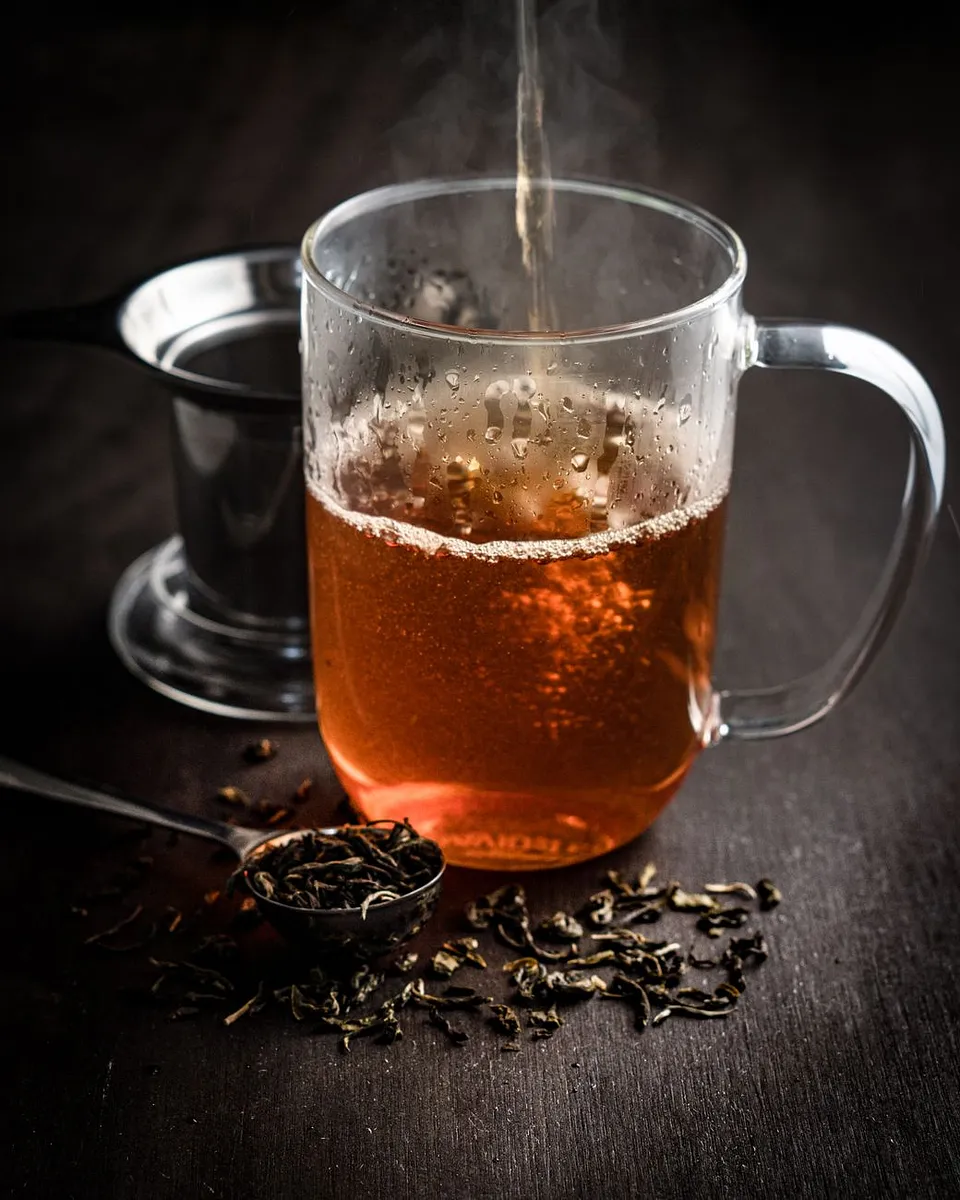
Steep tea too long and it turns bitter and drying — not because the leaf has spoiled, but because the water keeps pulling compounds out of it the entire time the leaves sit there. Extraction has no natural stopping point. You are the stopping point.
Which is good news, in a way. Over-steeping is one of the few tea problems with a single, obvious cause, and the fix costs nothing.
What actually happens when tea steeps too long?
Hot water pulls flavor out of a leaf in a rough order. The sweet, aromatic, immediately pleasant compounds come out early. The heavier ones — the tannins, a family of plant polyphenols — come out more slowly and keep coming.
In one study of loose leaf teas steeped from one to ten minutes, polyphenol content climbed the whole time, though most of what ever came out had already arrived in the first five minutes.1 That's the shape of the problem: the good part of extraction front-loads, and the back half of a long steep adds mostly the compounds you didn't want.
Why does over-steeped tea taste dry and puckering?
The drying feeling isn't a taste at all. It's friction.
Tannins bind to proteins in your saliva and precipitate them out, stripping away the lubrication that normally coats your mouth.2 What you register as "astringent" is your tongue moving against a surface that has briefly stopped being slippery. Bitterness is a separate mechanism — tannins also trip bitter taste receptors directly — which is why a badly over-steeped cup manages to be both bitter and drying at once.
Milk helps for exactly this reason. Its proteins give the tannins something to bind to other than your saliva. That's a real fix for a robust black tea, and a waste of a good oolong.
How long is too long?
It depends less on the clock than on the leaf. Small, broken leaves give up everything quickly and punish a long steep; large, whole leaves extract slowly and forgive a minute or two. A Darjeeling left thirty seconds too long can go from bright to harsh, while a large-leaf Ceylon barely notices. Here's the rough map:
- Green and white tea: the least forgiving. Past about 3 minutes, delicate sweetness gives way to a vegetal harshness.
- Oolong: 3–5 minutes in a mug, and genuinely hard to ruin at the shorter end.
- Black tea: 3–5 minutes. Sturdy, but a forgotten black tea at ten minutes is the classic bitter cup.
- Pu-erh: heat-loving and forgiving; over-extraction shows up as a heavy, flat cup rather than a sharp one.
- Herbal tisanes: effectively un-over-steepable. No tea leaf, no tannin problem. If chamomile tastes weak, the answer is more time.
The pattern worth remembering: the more delicate the leaf, the narrower the window.
Can you rescue a cup you've over-steeped?
Sometimes, and it's worth trying before you pour it out.
- Dilute it. Add hot water. An over-extracted cup is a concentrate, and concentrates can be cut.
- Add milk, for black teas — the protein trick above.
- Ice it. Cold blunts bitterness, and an over-steeped black tea makes a better iced tea than a mediocre one does.
- Start over, with less leaf. If you're consistently over-steeping because you like a strong cup, use more leaf and less time instead. Strength and over-extraction are not the same thing, and you want the first without the second.
What you can't do is steep the bitterness back out.
Pull the leaves, not the mug
The single habit that ends the problem: take the leaves out when the time is up, rather than taking the first sip and deciding. Use an infuser you can lift, a pot you can decant, or a strainer over a second cup. Leaves left in a mug keep extracting while you drink, which is why the last mouthful so often tastes worse than the first.
And set a timer. Two minutes and four minutes are different teas, and the gap between them is exactly the kind of thing a distracted afternoon erases — which is the reason we built one into the app. Set it, walk away, come back to the cup you meant to make.