
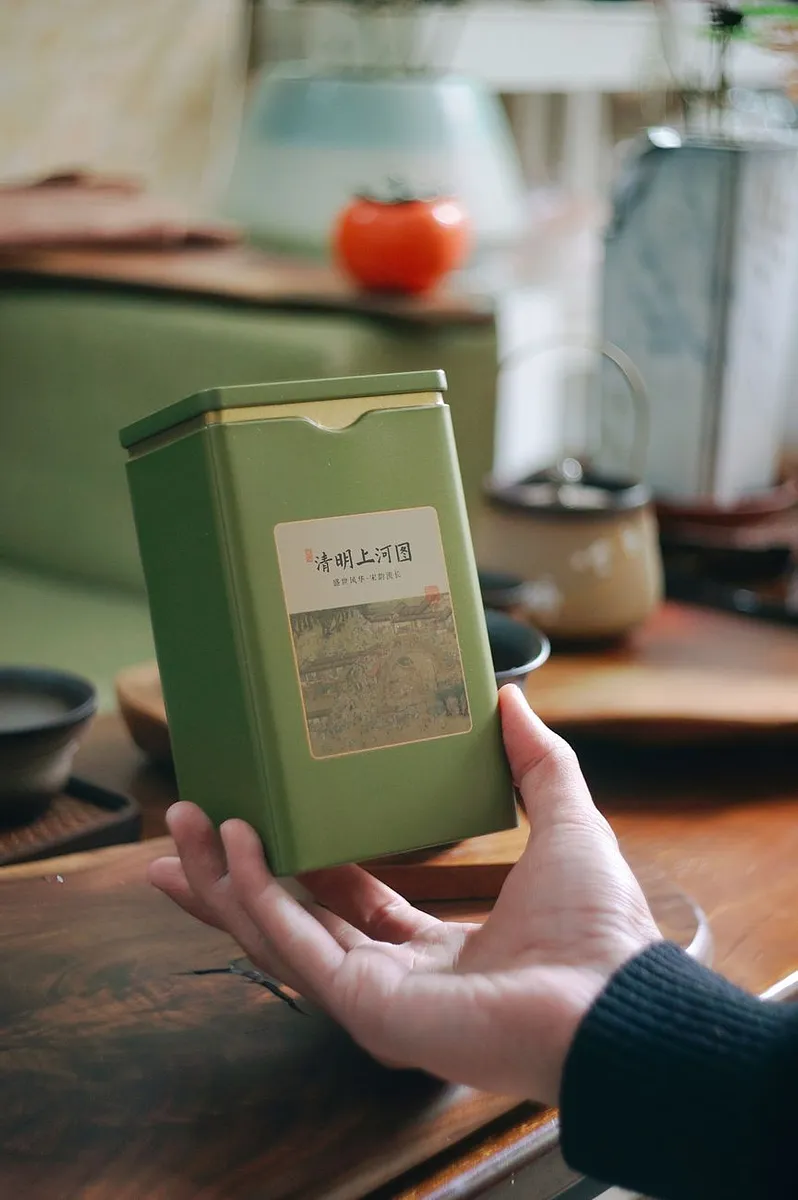
You can, but only some teas benefit and only if you do it carefully. Matcha and fine Japanese greens hold their color and flavor noticeably longer when kept cold in a sealed container. Most black, oolong, and herbal teas gain little. The real dangers are condensation and fridge odors, both of which do more damage than a warm cupboard ever would.
Cold storage is one of those tea topics where both camps are partly right. People who swear by the freezer are usually drinking matcha or sencha. People who say "never refrigerate tea" have usually opened a cold tin in a warm kitchen and watched it go limp. The difference is entirely in which tea, and how.
Why cold helps at all
Tea goes stale through slow chemistry: oxygen attacking pigments and aroma compounds, catechins breaking down, volatiles drifting off. Like nearly all chemical reactions, those run faster when it's warm and slower when it's cold.
The clearest evidence comes from matcha. Japanese researchers stored sealed bags of matcha at four temperatures for 24 weeks, tracking chlorophyll, vitamin C, surface color, and taste. At 4°C and at −70°C, the matcha stayed in good condition for the full six months. At room temperature (25°C) it held up only moderately, and at 37°C — a hot summer pantry — it had deteriorated badly within three to four weeks.1 Note that this was sealed, unopened product; once a tin is open, air does its work much faster.
Which teas benefit
The teas that gain the most are the ones with the most to lose.
- Matcha: the strongest case. Ground to powder, its whole surface is exposed, and its vivid green is chlorophyll that fades visibly with warmth and time. Unopened tins belong in the fridge or freezer.
- Japanese greens (sencha, gyokuro, shincha): good candidates, especially if you've bought more than you'll drink in a couple of months. They share matcha's fragile chlorophyll and fresh aromatics, just with less exposed surface.
- Delicate Chinese greens and lightly oxidized oolongs: a modest benefit for long-term stock, little for what you're drinking this month.
- Black tea, roasted oolong, and herbal blends: not worth the risk. They're already stable at room temperature, so cold buys little and the moisture risk stays the same.
- Pu-erh: never. Pu-erh is meant to keep changing, and cold storage stops the very process you're paying for.
The condensation problem
This is where most cold storage goes wrong. A cold container pulled into a warm room is below the dew point of the surrounding air, so moisture condenses on whatever is cold — the outside of the tin, and, if you open it, the leaves or powder inside. Dry tea takes up that water quickly, and moisture undoes everything the cold was protecting.
Humidity, in fact, may matter more than temperature. A Korean study of green tea powder stored for three months found the best preservation at 4°C with low relative humidity (23%), while samples kept at −20°C or 20°C under high humidity (69–81%) lost significant amounts of their catechins and other compounds.2 Cold alone isn't protection. Cold and dry is.
The odor problem
Tea absorbs smells readily, and that isn't folklore — it's how jasmine tea is made. Base tea is layered with fresh jasmine blossoms, and over several hours the leaves pull in both the flowers' aroma and their moisture.3 Your fridge runs the same process with onions, leftovers, and cheese. A loosely closed bag of sencha next to a cut half of an onion will taste of it, and there's no getting that back out.
The freezer is somewhat less aromatic than the fridge, but frost-free freezers move air constantly, and anything not fully sealed will pick up both odors and freezer burn.
How to do it right
- Freeze or refrigerate only unopened, factory-sealed packs where possible. That's the condition the research actually tested.
- Divide bulk tea into small portions first — a few weeks' worth each — sealed in airtight bags or tins, ideally with the air pressed out. Then you only ever warm up what you're about to use.
- Double-wrap. Put sealed packages inside a second airtight container or freezer bag as a barrier against odors.
- Let it warm completely before opening. Take the sealed container out and leave it on the counter until it's fully at room temperature — at least a few hours for a small tin, longer for a larger bag. Wipe off any condensation on the outside before you break the seal.
- Once a portion is open, keep it at room temperature in an opaque, airtight tin and drink it within a few weeks. Don't cycle it back into the cold.
What not to do
- Don't keep your daily tin in the fridge. Every time you take it out and open it, you're inviting a little condensation in. Repeated a dozen times, that's damp tea.
- Don't store tea in its paper box or a clip-sealed bag in the fridge. Neither is airtight against moisture or smells.
- Don't open a cold container to "just grab a scoop." This is the single most common mistake.
- Don't refreeze tea that has been opened and exposed to room air. Whatever moisture it picked up comes back with it.
- Don't bother for teas that don't need it. A good black tea in a cupboard tin will outlast your interest in it.
One honest caveat: most of the research tested sealed commercial packaging under controlled conditions, not a home freezer opened twice a day. The general principle — cold slows deterioration, moisture accelerates it — is well supported; exact shelf-life gains at home are not.
For most people, the simplest strategy is to buy small amounts and store them well, as covered in where to store your tea. Cold storage is a tool for the stockpile, not the everyday tin. If you're curious how long each type really keeps, see how long tea actually lasts, and for judging whether a matcha is still at its best, see how to tell the quality of matcha.