
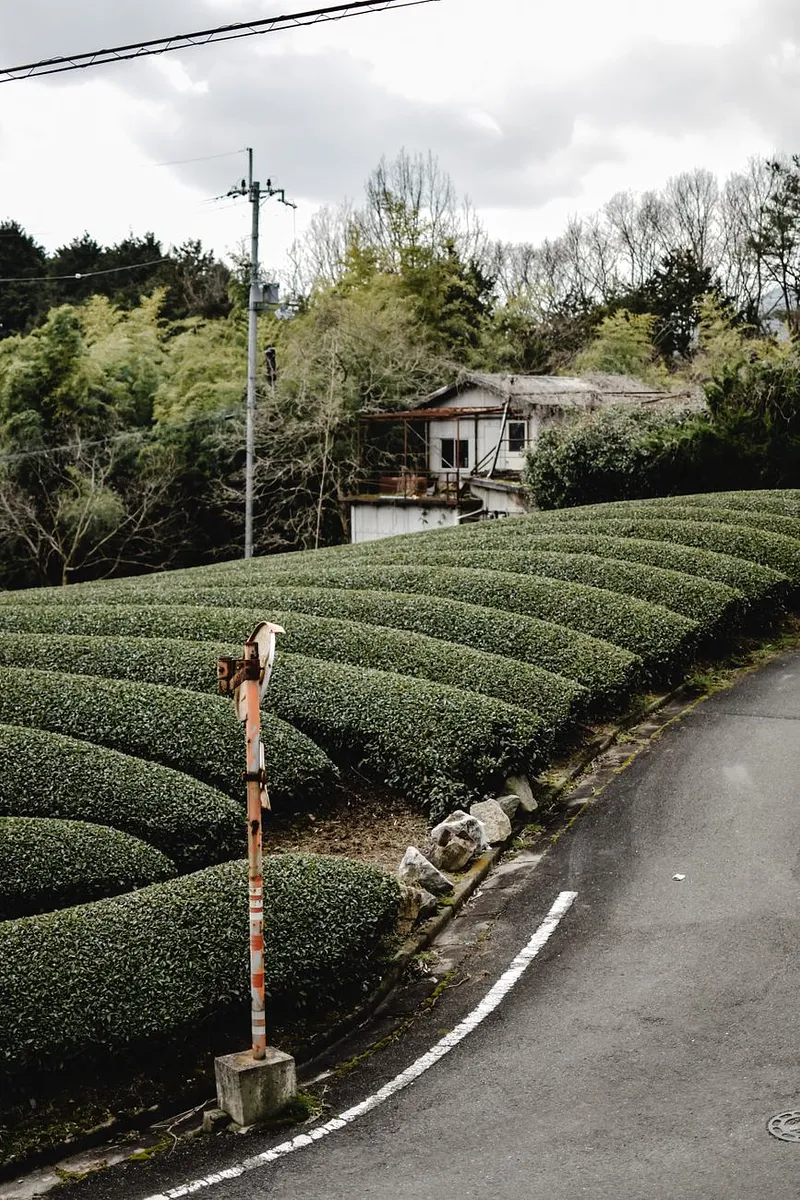
Gyokuro is a Japanese green tea shaded for about three weeks before harvest, which makes it unusually sweet and savory with very little bitterness. Brew it differently from other teas: a lot of leaf, a small amount of water at just 120–140°F, and about two minutes. The result is a few sips of rich, almost brothy tea.
The name means "jade dew," and it's the most prized loose-leaf tea in Japan. It's also the tea most often ruined by being brewed like every other tea. Here's what makes it different, and how to get it right.
What shading does to the leaf
Tea plants make L-theanine, an amino acid with a sweet, savory taste, in their roots and send it up to the leaves. In sunlight, the leaves convert much of it into catechins — the compounds behind green tea's bitterness and astringency — as a kind of natural sunscreen.
Cover the plant, and that conversion slows down. Theanine and caffeine build up in the leaf, and catechins fall.1 The leaf also turns a deeper green as the plant makes more chlorophyll to catch what little light it gets.
It takes heavy shade to get there. In one study of gyokuro-style tea, the improvements in theanine and caffeine — and in the price the tea commanded — only arrived when about 99% of light was blocked.2 That's why traditional gyokuro fields are covered with layers of straw or thick cloth, and why the tea costs what it does.
What it tastes like
Gyokuro is the clearest example of umami in tea: the deep, savory taste you'd recognize from broth or seaweed. Good gyokuro has:
- A thick, almost syrupy body, especially in the first cup
- Sweetness and savoriness in roughly equal measure
- A marine or steamed-greens aroma
- Very little bitterness, if brewed correctly
If your first impression is that it tastes more like soup than tea, you're tasting it right.
How to brew gyokuro
The technique runs against everything else you've learned about tea: more leaf, less water, much cooler.
| Gyokuro | Sencha (for comparison) | |
|---|---|---|
| Leaf | 5 g (about 2 teaspoons) | 4–5 g |
| Water | 2–3 oz | 6–7 oz |
| Temperature | 120–140°F | 160–175°F |
| First steep | about 2 minutes | about 1 minute |
- Cool the water a lot. Boil, then pour it into a cup, then into another, then wait. Each transfer cools it by 15–20°F. Your hand is a decent guide: water for gyokuro is warm, not hot.
- Use a small pot. A small kyusu, a shiboridashi (a lidded dish with a spout), or even a small teacup and strainer.
- Steep about 2 minutes. Cool water extracts slowly, so it needs the time.
- Pour out every drop. The result is a few small sips. That's the intended serving.
The second and third steeps
- Second: slightly warmer water, poured almost immediately. Brighter and greener.
- Third: warmer again, about a minute. Lighter, closer to sencha.
After the last steep, a Japanese custom: eat the leaves. Spent gyokuro leaves are tender enough to dress with a little soy sauce or ponzu and eat as a side dish.
Gyokuro or kabusecha?
Kabusecha is shaded for around a week instead of three. It has some of gyokuro's sweetness with more of sencha's brightness, it's more forgiving to brew, and it usually costs considerably less. If gyokuro seems like a big leap, kabusecha is the step in between.
Where gyokuro comes from
Two regions are famous for it: Yame in Fukuoka, which produces much of Japan's gyokuro, and Uji near Kyoto, where shade-growing was developed. Some producers still shade with traditional rice-straw covers rather than synthetic cloth, and the teas made that way are among the most expensive in the country.
Is it worth it?
Gyokuro is not an everyday tea for most people, and it isn't meant to be. It's a tea for slowing down — a few concentrated sips that make you pay attention. A small tin goes a long way, since each session yields several steeps.
If you've only ever had sencha, try gyokuro once, brewed carefully. It's the tea that shows how much growing conditions shape what ends up in the cup. Our guide to the types of Japanese green tea shows where it sits among the rest.