
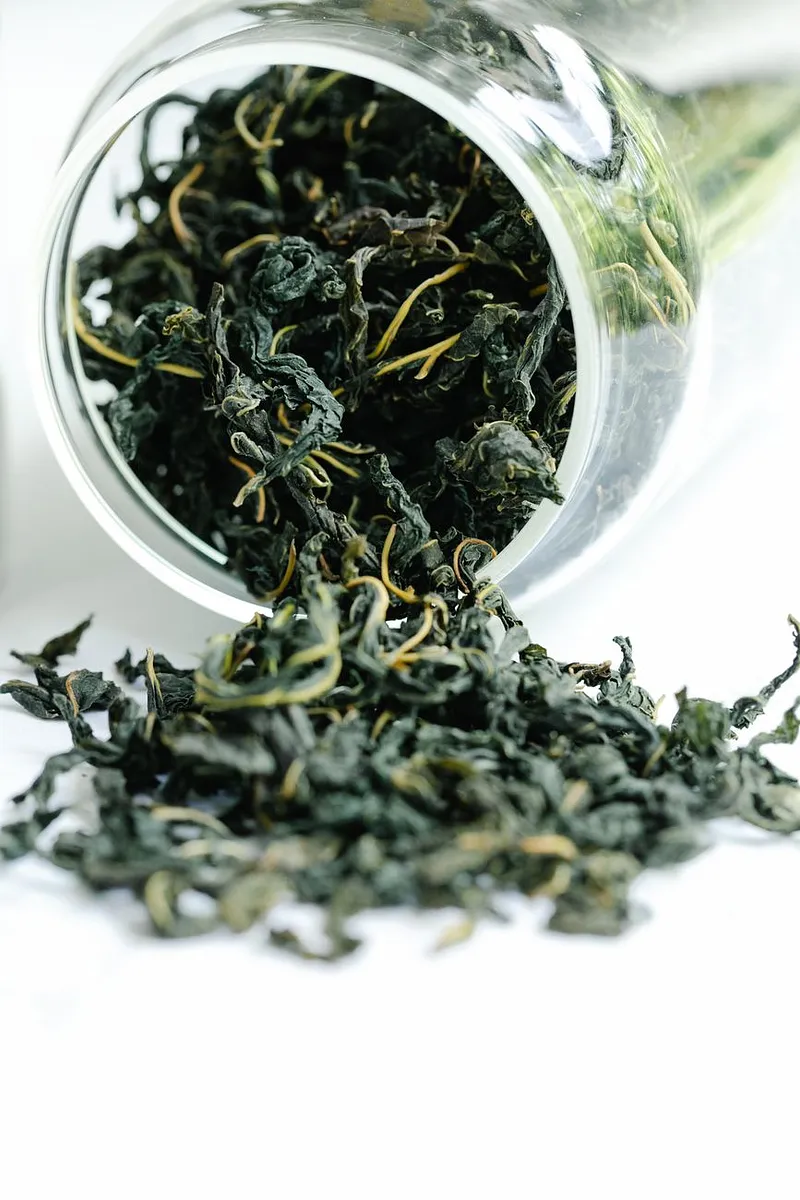
Oolong is partially oxidized tea — the broad middle ground between green tea, which is barely oxidized at all, and black tea, which is oxidized fully.1 That middle is enormous, which is why two teas both labeled oolong can taste almost nothing alike.
Understanding oolong is mostly a matter of learning which two questions to ask: how oxidized, and how roasted.
What does oxidation actually do?
When a tea leaf is bruised and left exposed to air, enzymes begin converting its compounds — the same browning process you see in a cut apple.1 Green tea is heated early to stop this almost immediately. Black tea is allowed to run to completion.
Oolong is stopped somewhere in between, and the maker chooses where. A lightly oxidized oolong keeps much of the floral, green character of the fresh leaf. A heavily oxidized one moves toward the stone fruit and honey of a black tea.2 Same plant, same field, entirely different cup.
The second question: roast
After oxidation, many oolongs are roasted — sometimes lightly, sometimes over charcoal for hours across several sessions.
Roast is a separate dial from oxidation, and this is where most confusion comes from. A lightly oxidized oolong can be heavily roasted, producing something dark and toasty that still has floral bones underneath. A moderately oxidized one left unroasted tastes bright and fruity. Two dials, four corners, and every combination exists.
Roasted oolongs also age well, which lightly oxidized ones generally don't.
The shapes, and what they tell you
- Rolled into tight pellets. Typical of Taiwanese and some Fujian oolongs. These unfurl dramatically over several infusions and are the best re-steepers in tea — six to eight rounds is ordinary.
- Striped or twisted. Typical of Wuyi rock oolongs and Phoenix Dan Cong. Long, dark, wiry leaves. Usually more oxidized, often roasted, and generally the more savory and mineral end of the category.
Four worth knowing by name
- Tieguanyin (Iron Goddess). From Fujian. The modern style is lightly oxidized and green, intensely floral — orchid and lilac. Traditional versions are darker and roasted, and taste like a different tea entirely.
- High-mountain Taiwanese (Alishan, Lishan, Dong Ding). Grown at elevation, lightly oxidized, creamy and sweet with a thick texture. The easiest oolongs to love.
- Wuyi rock tea (Yancha). From the cliffs of Fujian. Heavily roasted, mineral, with a character the Chinese call yan yun — "rock rhyme," the stony quality the growing site imparts.
- Phoenix Dan Cong. From Guangdong. Famous for tasting convincingly of specific flowers and fruits — honey orchid, almond, grapefruit — without anything being added.
How to brew oolong
Oolong tolerates a wide range, and the two approaches give genuinely different results.
In a mug: 195–205°F, 3–4 minutes, about a teaspoon per cup. Use the cooler end for green, floral oolongs and the hotter end for roasted ones. Re-steep at least once, adding a minute.
Gongfu style: far more leaf — roughly 5–7 grams per 100 ml — with steeps measured in seconds. Rinse the leaves briefly, then start around 20 seconds and add a few seconds each round. This is where rolled oolongs justify themselves; the arc from the second infusion to the fifth is the most interesting thing in tea, and a mug flattens it into one cup.
Where to start
If you've never had oolong, start with a high-mountain Taiwanese one. It's the most immediately likeable — sweet, creamy, forgiving of brewing mistakes — and it demonstrates the multi-infusion character that makes the category worth the attention.
Then try a roasted Wuyi. If you like both, you've discovered that oolong isn't a flavor but a range, which is the only thing about it worth memorizing.
Whichever you start with, our oolong steep timer will keep the water and time in range while you're still learning the leaf.