
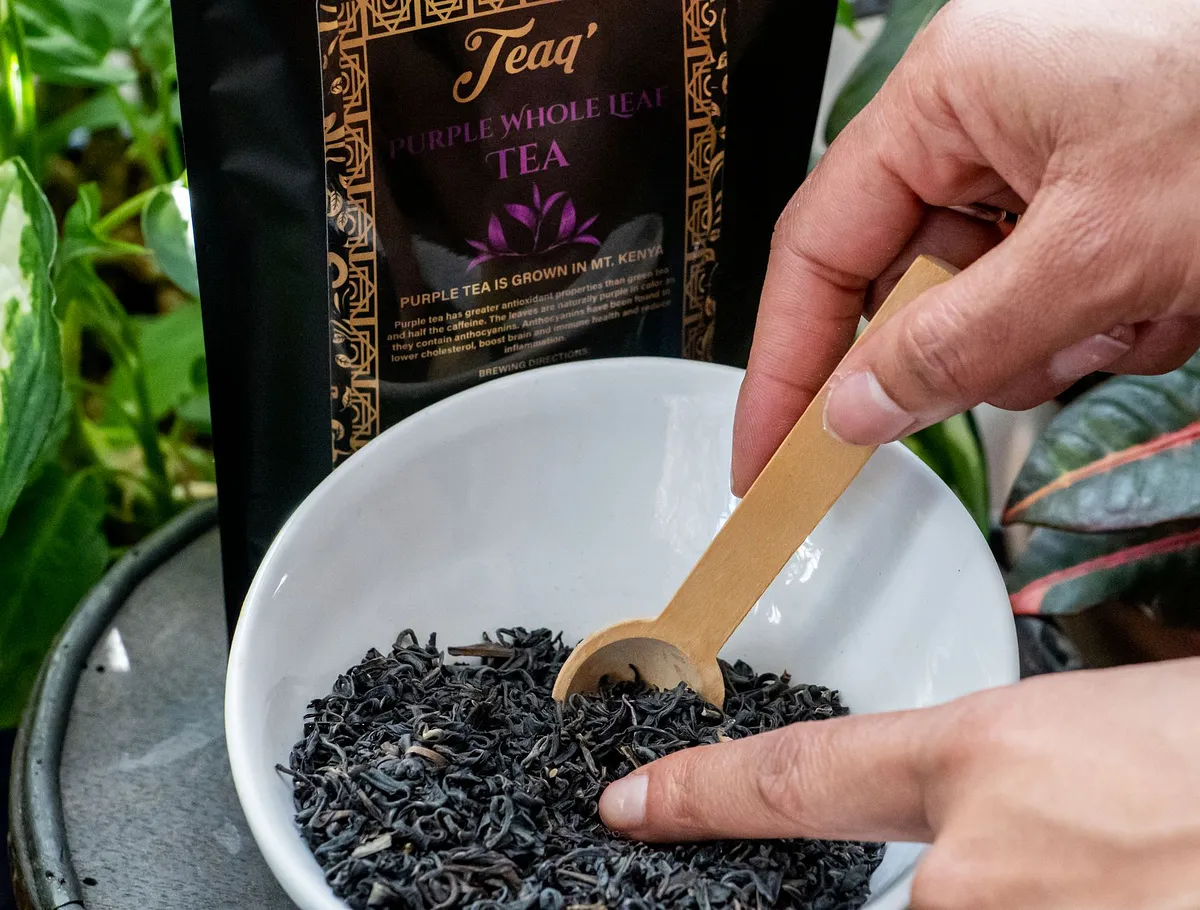
Use about one teaspoon of loose leaf per 8 oz cup — or, more reliably, 2 to 3 grams. The teaspoon works well enough for most teas and fails badly for a few, which is the whole reason this question keeps coming up.
Tea companies have long printed "one teaspoon per person and one for the pot" on the tin, which is a fine rule for a brisk breakfast blend and a poor one for almost anything else. Leaf quantity is the lever most people never touch. They adjust steeping time instead, and end up with bitter tea when what they wanted was strong tea.
Why a teaspoon isn't really a measurement
A teaspoon measures volume. Tea is sold, and behaves, by weight.
Those line up fine for a mid-sized broken leaf, and come apart completely at the edges. A teaspoon of tightly rolled oolong pellets might weigh three times what a teaspoon of fluffy white tea does — same spoon, wildly different cups. Big twisted leaves trap air; dense rolled ones don't.
The international standard for tea tasting specifies 2 grams per 100 ml precisely to eliminate this problem.1 That's a laboratory ratio meant for comparing teas rather than enjoying them, but the principle holds: if you want a cup you can repeat, weigh it.
Adjusting by leaf shape
Until you own a scale, adjust the spoon by eye:
- Tightly rolled (gunpowder green, high-mountain oolong): use a scant teaspoon. They're dense in the spoon and expand dramatically in the water.
- Broken leaf (most breakfast blends, CTC black): a level teaspoon. This is the shape the standard advice assumes.
- Large, twisted, or fluffy (white teas, some whole-leaf greens, most herbals): use two teaspoons, sometimes more. They take up enormous space for very little mass.
- Powder (matcha): different category entirely — whisked into the water, not steeped, usually about 2 grams.
Strength versus bitterness
This is the part worth internalizing: more leaf makes tea stronger, more time mostly makes it bitter.
Extraction front-loads. The sweet, aromatic compounds come out early; the tannins responsible for astringency keep coming out for as long as the leaves sit there. So a long steep doesn't scale strength up evenly — it shifts the balance toward the harsh end.
More leaf with a shorter steep gives you a cup that's concentrated but still sweet. That's the trade gongfu brewing makes explicitly, using around 5–7 grams per 100 ml with infusions counted in seconds rather than minutes.
If your tea is weak, add leaf. If it's bitter, cut time or temperature. Those are two different dials and they are not interchangeable.
When a scale is worth it
A small digital scale costs very little and changes tea from something you approximate to something you reproduce. It's worth buying at the point where you catch yourself thinking "that cup was really good" and having no idea how to make it again.
You don't need it on day one, and plenty of people brew happily for years without one. But it's the cheapest piece of equipment that meaningfully improves consistency, and unlike most teaware it's genuinely useful for other things.
The practical version
- One 8 oz mug: 2–3 grams, roughly a teaspoon, adjusted for leaf shape.
- A 16 oz travel mug: double it. People routinely under-leaf large vessels and then over-steep to compensate.
- A small teapot for two: weigh it. Guessing scales badly.
- Re-steeping: keep the same leaf and add time to each successive round.
Start at the low end and work up. Adding leaf to a weak cup next time is easy; a cup that's already too strong can only be diluted.